______________________________________________________________________________________________________________________________
Radu Tîrcă and Ștefania Hîrleață are students at University of Architecture and Urbanism 'Ion Mincu', Bucharest. At present, they lead their theoretical research on the subject of thermal towns and diploma projects in Govora Baths under the guidance of Stefan Simion, Irina Tulbure and Ilinca Paun Constantinescu. As students, they won second prize and best student project in a BeeBreeders international architecture competition - Mango Vynil Hub, third prize in a Zeppelin national competition - Prototip pentru comunitate, as well as other mentions in other competitions.


Showing Everything
Kersten Geers
published in OASE, no.94 (OMA, The First Decade), Rotterdam, 2015, republished in Kersten Geers, Without Content, 2G Essays, 2021.
OMA’s Netherlands Architecture Institute (NAi) is perhaps the most important building the office never built. In light of what came afterwards-a set of gigantic buildings with towering inner complexity, all more or less incarnations of “Bigness, or the Problem of Large”, i.e. OMA’s key manifesto for the nineties-it is easy to be underwhelmed by the modest size, the simplicity or even the banality of the design for the NAi. Perhaps, more than in other projects of the first decade, what you see is not what you get. A haphazard accumulation of architectural elements is brought together under a simple and strangely elegant tilted roof: a nondescript container of modest proportions, consciously underperforming. If OMA’s NAi is an endpoint of sorts, then it is the final incarnation of its investigation into the “idea” of architecture. Form is both the consequence and the subject of this pursuit; the idea of the spatial principles of architecture is the weapon of choice.
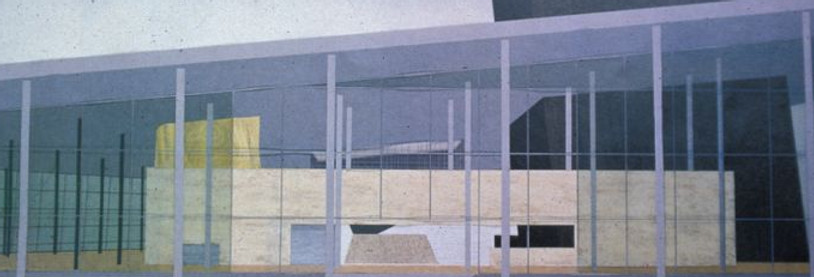
The NAi project is probably best known through a set of elaborate façade drawings and a monumental zoom of this façade a collage that is by far the most particular product. Because of its specific aesthetic and material “thickness”. It makes for one of the most compelling re-incarnations of Miesian composition-wit in the fourth quarter of the last century. The meticulously constructed perspective shows carefully composed layers of abstract material in subtle overlap, and it presents a somewhat complex but equally simple exploration of late-modern space. Caught between Colin Rowe and Robert Slutzky’s first and second concept of transparency, it seems to rework the language of the equally flat collages of Mies van der Rohe’s Resor House Project and Museum for a Small City, in the opaque manner of Le Corbusier: everything is visible, yet nothing is clear.
The mostly parallel placed material-surfaces enhance the references to the canon of mid-century modernism. Mean- while, the composition of the surfaces and textures, straight but not too straight-organised into two groups with slightly tilted angles-undermines the perception of a simple “re- boost”. The modernist perspective we seem to recognise is wilfully sabotaged. Probably because of this constructed dissonance, the view is extremely elegant. Spatial ideas of architecture are elegant assets.
1
2

The Netherlands Architecture Institute, OMA, Rotterdam, Netherlands, Competition Project, 1988.
The framing of the perspective is an act of architectural cunning in itself, as it manages to show a great deal by revealing very little. Consciously limited, and focusing on that part of the building where a deep slice in the surrounding ground level reveals a black pedestal, the view suggests a building with a glass and column structure that rests on a black base, half dug into the ground. It monumentalises both the hall and the content. The precision of the frame brings the argument, as presented by the perspective, full circle: the NAi as the self-declared endpoint of monumental modernism. Complete and complex, refined and self-centred, it sells the tropes of a fugitive modernism to Rotterdam, a city that personified by a modernist past it never quite got rid of. As tradition prescribes, the perspective is where the story is told, but not where it happens. OMA’s NAI is a big box lost in the Netherlands. A building that ignores, from the outset, the place it was intended to populate. Not out of arrogance, but simply because it understands that place is not an important context for an architecture institute. The context here is not location, the context is Architecture. How to make a building about Architecture? For OMA (in 1988) there was only one way: a building that is “the least architecture possible” in order to contain the unavoidable; a receptacle for architec- ture, in perpetual conflict with its content. A big box born full: OMA’s NAi is a container of Form.
The container captures maximum volume under a single tilted roof, carried by a simple structural grid, 6 by 6 m. The field of columns rigorously takes stock of the terrain. The grid seems both necessary and irrelevant. It is the perfect incarnation of the idea of the column as architectural device. This becomes clear in the project description: “In the exhibition space these columns play the role of bridge between the exposed objects and space itself. To enable larger installations (e.g. full-size reconstructions), one of the columns can be taken away”. The structure does not really care about its structural feats; it does carry, but fundamentally it organises the site visually. The grid is cut at the edges of the site: columns are taken away, one by one. The few columns left make up the three façades of the building: a colonnade that carries the façade or the cantilevered roof, defining a territory that coincides with the one defined by the grid. The sharp sloping triangle creates the volume of the big box. The three façades-glass with a slightly different colour and opacity-form another more or less autonomous perimeter, following its own rules. If the column is presented as a tectonic device rather than as a structural or technical element, the façade becomes autonomous in its own right: strangely immaterial, but fully conscious of its dividing powers. Perhaps to emphasise this, one of the façades is drawn in an elegant curve, subtly disconnecting itself from column and roof, where in the other two instances the glass simply joins the dots of the columns.
This design is a set of overlapping perimeters, presenting different ways to define a precise territory, a space. The field of columns, the projection of the roof and the (almost) triangular perimeter of the façade are composed around the same point of gravity: the space they define together. Inside, in the gravitational centre of the space, one finds an accumulation of abstract forms. A huge, slightly tilted tower attached to a flat block with a patio that functions as a pedestal, filling up the middle of the building. The black tower evokes many things. From Kazimir Malevich’s Black Square (the zero degree of painting) to the Kaaba (a volume so black it hints at the indescribable), it incarnates Form as a piece of relentless mass: only volume, no detail. The patio block seems to hint at form as type: a volume with an opening that organises everything unknown. Together, tower and block present the purest manifestation of architecture as form. Only a limited amount of space remains in the box, as if the triangular building was made to house and frame these strange forms. Not unlike the Pergamon Museum in Berlin, which houses reconstructed monumental building parts transported from Turkey, this institute brings together fragments of architecture that start to mutate ambiguously with the very building that protects and contains them. The result is a confusing status of object and pedestal.
In the end, there is so little room left for the “programme” of the institute that one can only conclude that the construction itself rendered the programme irrelevant. Everything that is supposed to happen, essentially happens on top of, in between, and somehow in the fringes of the projected architecture. Using this NAi is like appropriating a temple. Of course: there are exhibition halls, lobbies, a library and coffee places. But because of the looming presence of architecture (as it- self), all that becomes quite secondary.
Is that the endpoint OMA reached in 1988? If architecture is able to be both space and form, one becomes the “context” of the other. As sculpture and pedestal, both are intrinsically intertwined. One does not survive the absence of the other. Looking back at the particular detail of the zoomed-in collage reveals that all this is consciously on show. The cut, revealing the pedestal-like base of the envelope, also “creates” a bridge to enter the very building, and to leave Rotterdam. Cut and bridge show the power of obstruction. Inside the insti- tute everything is available, everything is shown. Curiously enough, this land of plenty is as oppressive as it is liberating. It turns into a container cut loose from every context, in order to indulge in the glorious presence of nothing but architecture. The demonstration of its powers is therefore simultaneously the mise-en-scène of its limits. Architecture becomes both exposition device and exposition material. It undoes itself of every possible criterion of success... an absolute architecture... a building that can only refer to itself: an institute for architecture that is impossible to build.

The Netherlands Architecture Institute, OMA, Rotterdam, Netherlands, Competition Project, 1988.
1 - Koolhaas, Rem, “Bigness, or the Problem of the Large”, in Koolhaas, Rem and Mau, Bruce, S, M, L, XL, New York: The Monacelli Press, 1995, pp. 495-516 (editor’s note).
2 - See Rowe, Colin and Slutzky, Robert, “Transparency” (1955-1956], Perspecta, no. 8, New Haven, 1963, pp. 45-54 (editor’s note).